


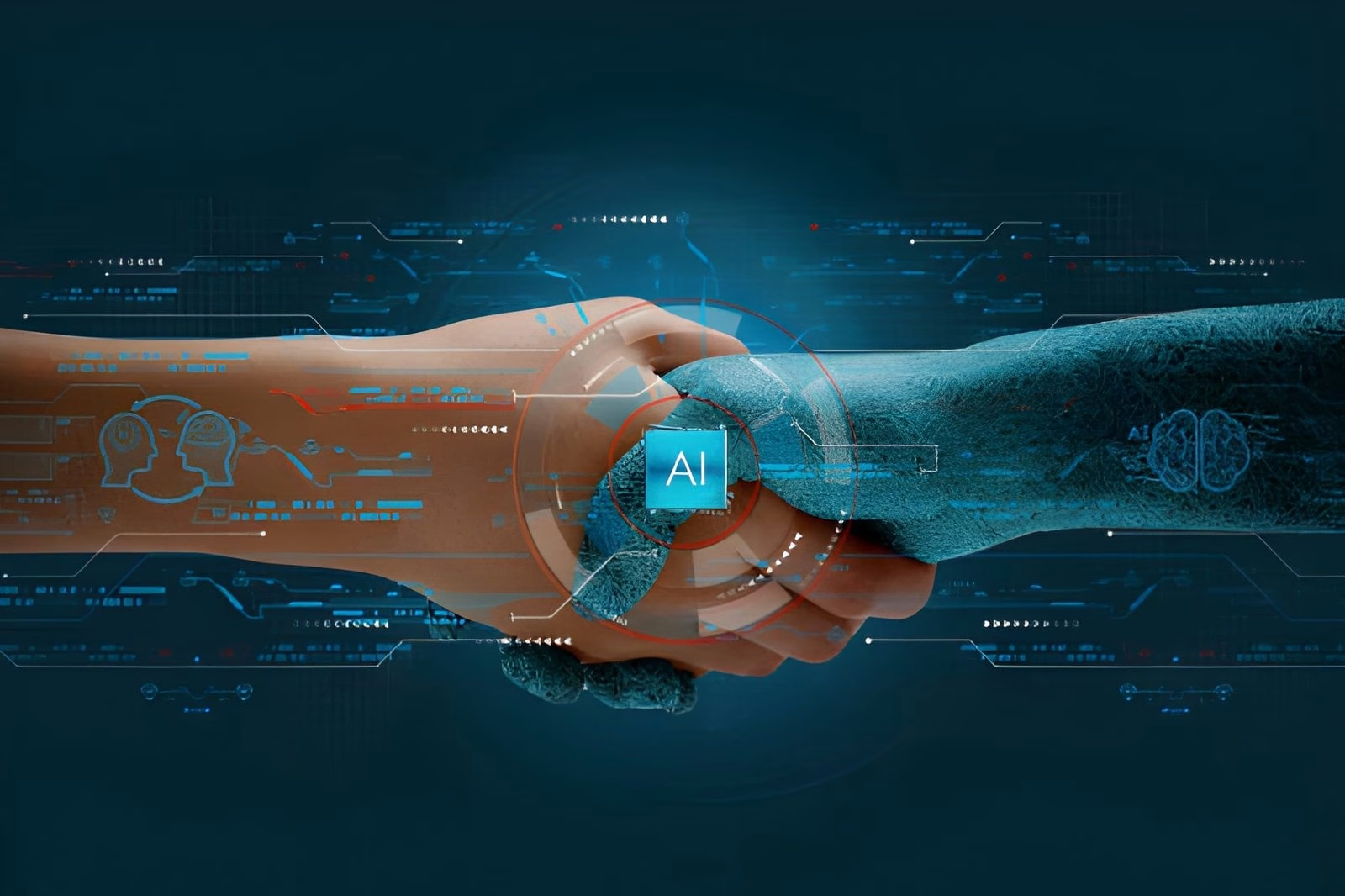
Let me begin with an interesting incident happened in my university few days ago. We had the privilege of hosting a distinguished personality (Dr. Madhavi Lata Ji ) who visited and shared her perspective on AI and Human Collaboration. After her session all of our friends had diverging opinions. Some argued that AI makes life easier – like helping us study faster, giving quick answers and even saving time in daily tasks. While some felt AI makes people lazy or too dependent on technology.
Recently I came across something called Industry 5.0(The Fifth Industrial Revolution) and my first thought was:-Oh God! One more revolution.
But now, I’ll explain it to you in my own way.
What Most People Miss About Technological Change
Let’s go back to the time when steam engines were introduced to us, or when we saw an evolution of electricity, or even when computers became a part of our daily work. My friend’s father was an accountant and he feared that computers would take away his job. Now here’s the irony. Her father ended up spending his entire career working on computers.
Work changed ? Absolutely !Some jobs disappeared? True!. But new opportunities also emerged. People adapted it and things went back to normal.
I am not saying change is easy, it can be difficult and it doesn’t affect everyone the same way. But the belief that technology just deletes humans from the picture? History proves it wrong every time.
What is Industry 5.0?
Let me break it down for you. Industry 5.0, or the Fifth Industrial Revolution, is the latest stage of industrial development where humans and advanced technologies like artificial intelligence, robotics, and humans work together instead of replacing each other.
And here is that one thought that struck my mind when I read about it.
AI is incredible in making work faster, safer, more accurate, and more efficient. But ask AI to handle a situation where a person is frustrated about some logic. To make decisions when there’s no data. Or why something feels wrong even when numbers are technically right.
AI will struggle. Why? Because some perceptions don’t come from the internet or AI, it comes from experience, knowledge, practice that is gained by actually going through things.
Industry 5.0 says that machines can’t do everything perfectly and humans aren’t perfect either, so what’s the solution? They should work together, each doing what they do best to create a more effective outcome.
Real-Life Examples of AI and Human Collaboration
Doctors use AI to analyze medical data, but doctors are still essential for making final decisions and caring for patients.
In the corporate sector, managers do use AI to track market trends. But AI can not make real life decisions based solely on some graphs. Someone still needs to handle the situation and to make decisions.
Not just in technical skills , but also in students’ daily life(speaking from my own experience), we do use AI for solving math problems or coding help, but learning the steps and practicing on our own is necessary to actually gain knowledge.
How ITM SLS Baroda University is Embracing Industry 5.0
My university is also adopting the ideas of Industry 5.0 in a very practical way. It not only encourages the use of AI tools but also focuses on development of human thinking ,creativity and problem solving skills. We are motivated to think out of the box and come up with our own unique ideas.
ITM SLS Baroda University believes that smart decision-making comes from a balance between technology and human judgement. Teachers also play an important role in guiding us on when and how to use AI effectively, by not being completely dependent on AI. This approach helps us become more self-reliable and innovative.
My Perspective: AI vs Humans or AI and Humans?
To conclude ,based on the above discussed facts and logics I believe that it’s not AI versus HUMANS, but it’s AI AND HUMANS.The key is not to just act like a robot or compete with machines, but to be yourself,using your creativity and judgement alongside increasingly capable AI tools. And just as we have successfully adapted to the past changes , we will continue to find smart solutions for the challenges ahead.